

With the release of Octopath Traveler 0, Square Enix showed that it was willing to revive its mobile live service games with full console game adaptations. I adored 0, even with some of its storytelling issues, because the core experience of an Octopath Traveler game is wonderful. This year’s Final Fantasy Resonance is seeking to do the same by turning the Final Fantasy Brave Exvius mobile game into a console RPG. This seems to be like a much bigger overhaul, trying to recreate the entire experience to better fit that of a classic Final Fantasy game. As the marketing continues to claim, this is the first HD-2D Final Fantasy game.
Defining what really makes for a “classic” Final Fantasy can be a bit difficult, but I think what people really miss are the visual abstractions that can make a small adventure feel grand. Our imagination can do wonders with very little, and the shift to HD had developers try to depict everything they had in mind in high fidelity. This is why I think the games after Final Fantasy XII were so divisive, since the technology improvements clashed with how expensive games became to make.
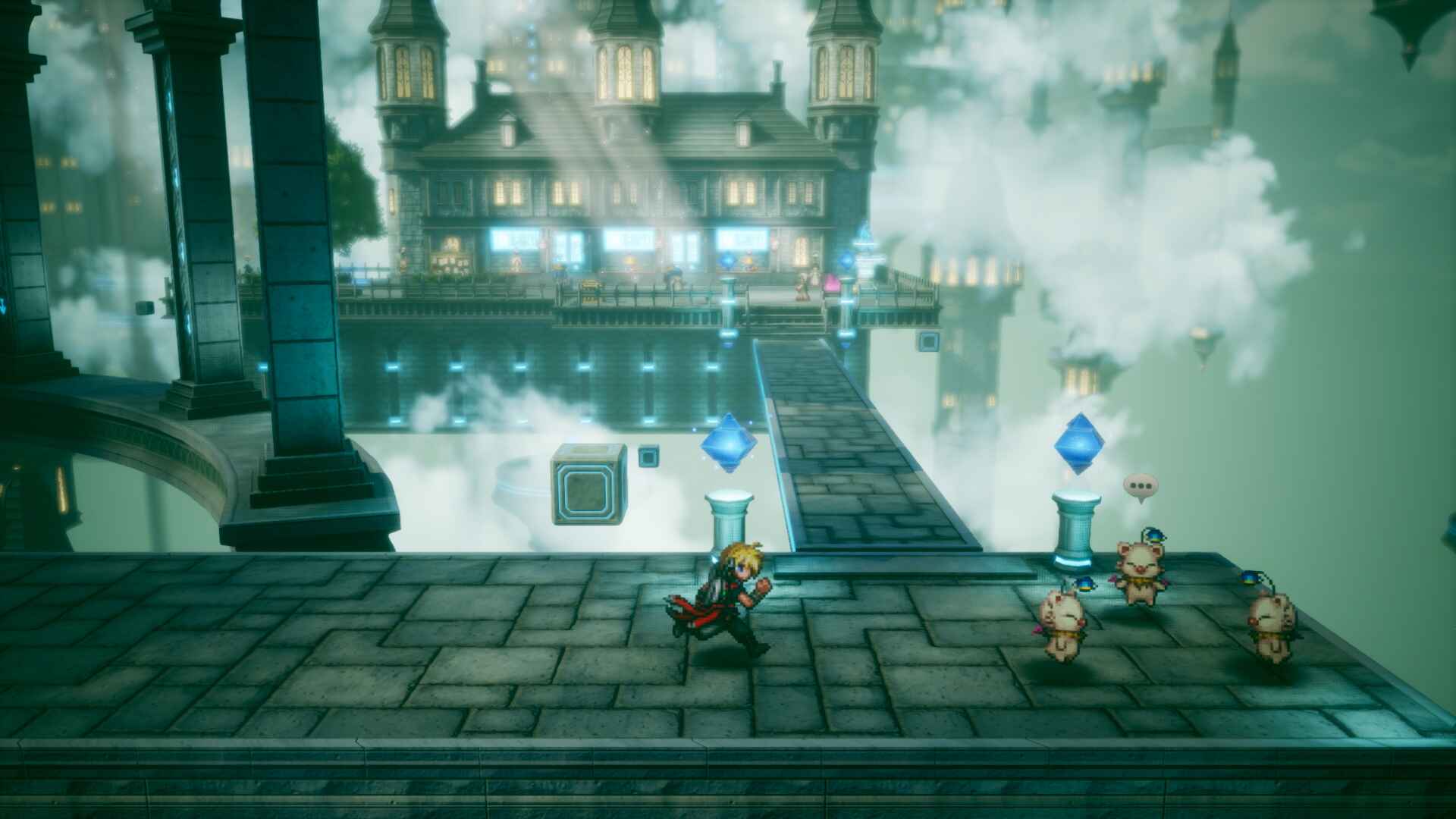
Resonance, in playing to the strengths of HD-2D, is able to present nostalgia in the shiniest way modern rendering techniques are able to. The pixel art is incredibly detailed, but all the abstractions of a classic RPG are back for this game. You have an overworld map to explore, towns that consist of a couple of screens at most, dungeons to delve into, and random encounters to keep the pace just slow enough for you to feel the scale of the adventure. There’s a lot of side content spread throughout the world, and you don’t really feel like your time is wasted. You’re basically always out in the world, in a dungeon, or battling.
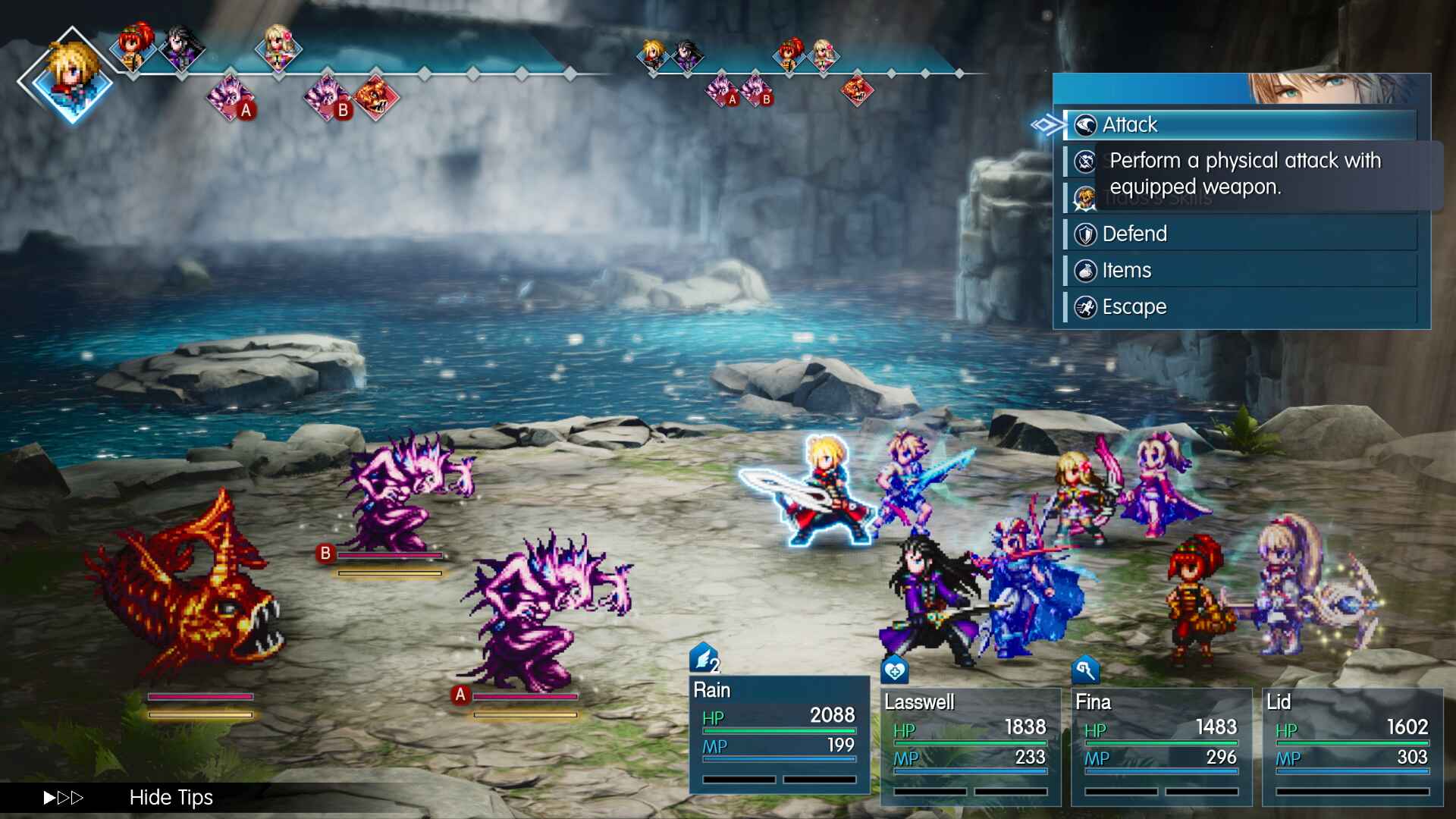
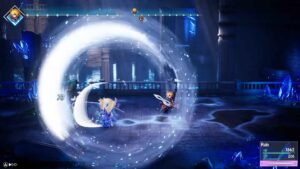
Combat is turn-based, with a focus on the modern trends of exploiting weaknesses to whittle away at enemy stagger bars. Once you figure out enemy weaknesses, battles involve applying pressure while staying alive until every enemy is staggered. This will allow your team to get additional turns and unleash one of four equipped special Vision attacks. The true depth of combat comes from character building, and building a party of four that feel well suited to break staggers on the largest variety of enemies possible. The enemy pool is very deep, and the weakness variety is dense, so this part of combat never really got dull.
Visions are the carry-over from the game’s gacha roots, and add another layer to the game’s job system. Every party member has a set job, and so does every Vision. You can mix and match these as you see fit to either make that character play more optimally in their role, or make up for their weaknesses. They all have levels to grind exclusive to the character that equips them, from 1 to 9. Each level gives you a permanent stat boost, a new ability to equip, or increases the number of abilities you can select. Maxing out a Vision with a character even allows you a shortcut ability to equip all of their abilities at a discount.
It was fun to decide if it was better to focus on only one Vision for a character at a time, or rotate the available Visions in and out to quickly get the early AP boosts and initial stat improvements. I initially focused on Visions that complemented the latent jobs each character had, before diving deep in the end and cycling all kinds of different Visions with different characters to combine all kinds of different skills. Eventually, with enough grinding, you can max out every Vision for every character, but AP and the limit of only eight ability slots will still prevent everyone from feeling too homogenized. The closest this gets is that Terra has a passive that increases the damage cap, which is useful to just about anyone you’re taking into the end game. I wouldn’t say there’s a single Vision that didn’t have worth of some kind. The rate at which you gain Vision experience is also so well paced that it wasn’t until the very final dungeon that I was able to start having every character maxing out a large amount of Visions. Even at the time of the final boss, I’d have probably needed to grind for a few hours to max them all out. For a game with a ton of battles, that’s impressive.
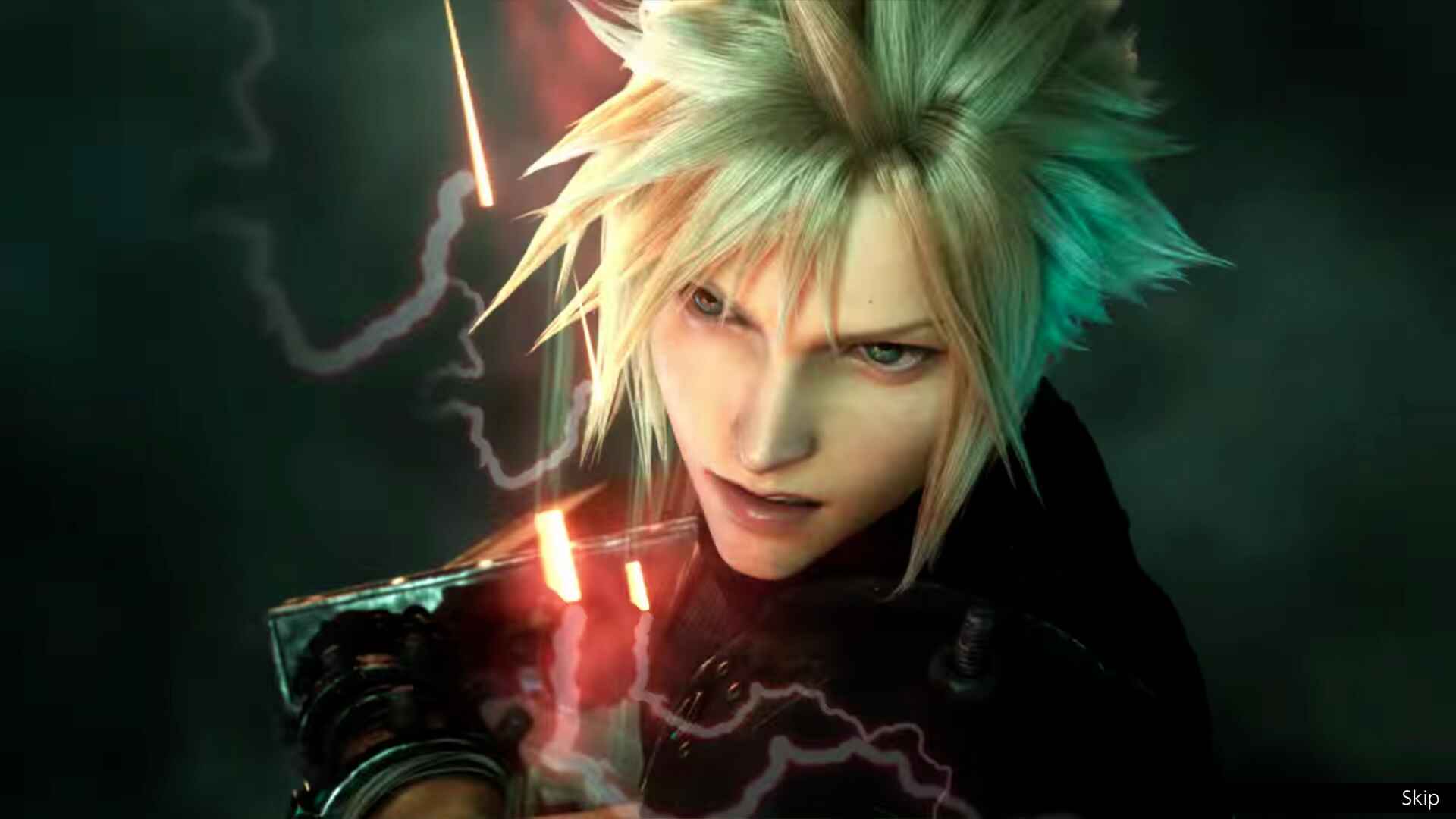
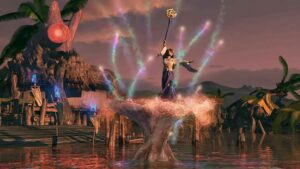
The Visions are made up of iconic Final Fantasy heroes and a couple of unique characters exclusive to this game that you unlock from side quests. Every mainline Final Fantasy game has its hero (except for the MMOs, which get Shantoto and Y’shtola) as a Vision you can unlock as you explore the world and find their shrines. It was cool to see pixel art of the heroes, especially the ones from 3D games, and their special attack animations are gorgeous. However, I found it a bit disappointing that there’s no real attempt to make the cameo characters feel like part of the world. They’re only here for battle, which made me a lot more interested in the unique Visions for the game. Also, the Final Fantasy cameos are only voiced in Japanese, which will be immersion-breaking for anyone playing in English. If Resonance ever were to get a follow-up, I hope they cut the cameos and make an entire Vision roster of only new characters.
Resonance is trying to harken back to classic Final Fantasy, so of course I was delighted to find the really steep difficulty spike in the back half of the experience. Even on Normal, enemies and bosses put up a real fight, and I actually felt punished for going into boss fights without optimal party setup. I also frequently found myself at the mercy of MP management, with power abilities draining your MP pretty fast. I really missed RPG dungeons that I felt I’d have to leave to stock back up on items or rest at an inn. In an effort to cut perceived “tedium” in these games, they’ve started to largely feel like a cakewalk, but Resonance kept me on my toes.
Gil will come to you steadily by doing battles, but MP and HP restorative items can cost a lot if you also want to keep your gear up to date. I only wish that dungeons were a bit longer to put the squeeze on me more, since many of them are pretty simplistic. You’ll have maybe two to three screens for each of them, and by the end of the game a lot of them drop puzzles and mechanics. There are some pretty interesting gimmicks early on that were engaging to explore, but I guess there’s something to be said about the team focusing on quantity over quality. There are a lot of dungeons in this game, and they’re all very visually diverse but start getting a bit simplistic by the end.
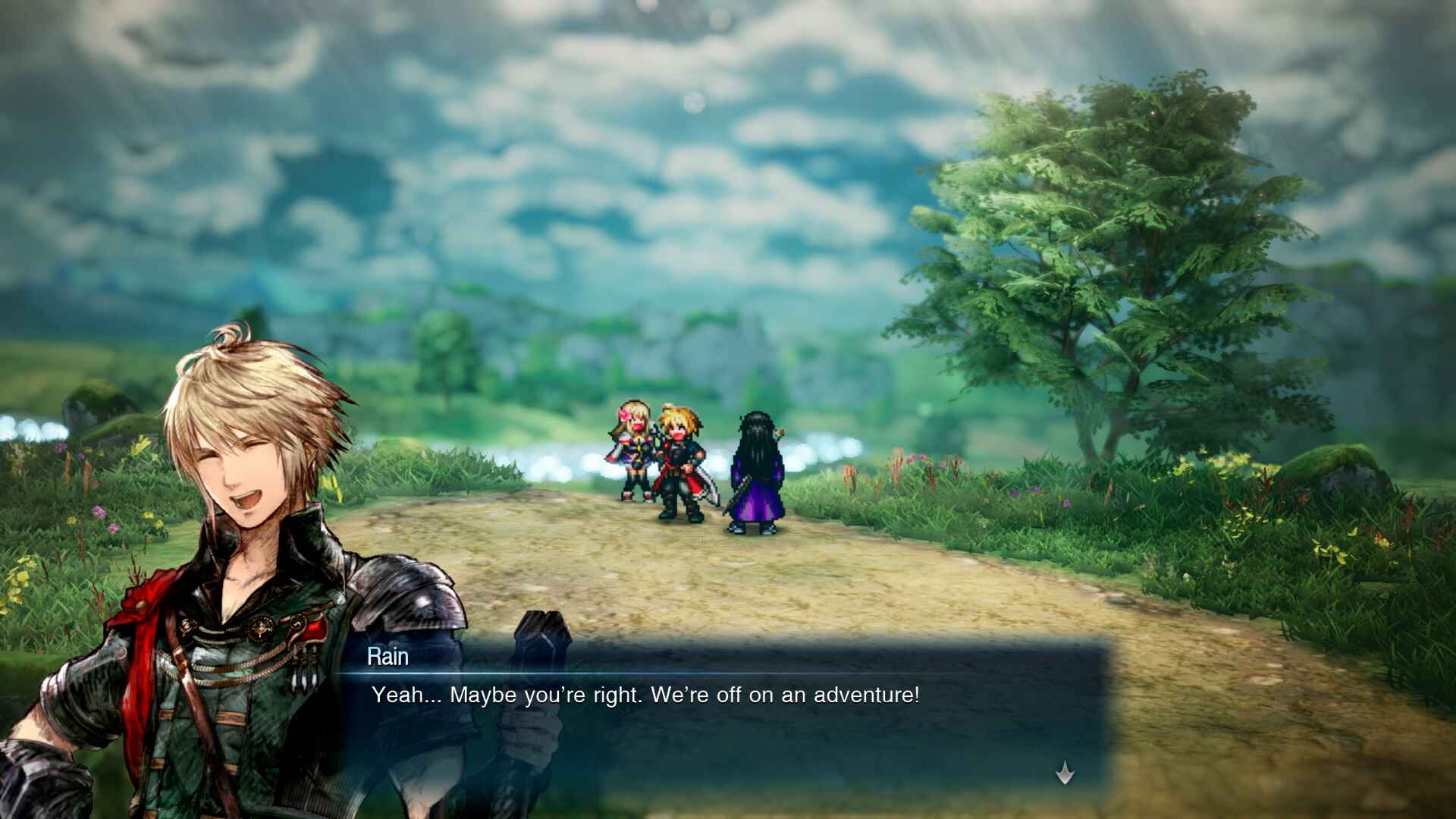
The real sticking point for Resonance is that the story is just kind of generic. Not every Final Fantasy has had a legendary story, and admittedly the first six games often are going for simplistic tales of good versus evil. Final Fantasy VI is where the writing starts to truly lean into introspective and complex, but Final Fantasy IV and Final Fantasy V feel like Shonen-inspired attempts at a similar goal. You’ve got simple plot beats highlighted by Hype Moments and fun characters to keep you going, and that’s exactly why I enjoy IV and V so much. This is the realm Resonance is trying to strive to plant its flag in, while also once again doing the tried-and-true Save The Crystals narrative.
Rain and the team of charming yet simple adventurers he gathers on his quest use the power of their bonds together. Rain himself is a bit boring, but the party around him is fun to watch. You’ll learn more about them with their side quest chains, but I’d say the best characters of the bunch are Laswell and Fina. Laswell has a genuinely interesting arc of him trying to find out if he’s happier in or out of Rain’s shadow, and Fina’s split personality plays off a trope I think is just fun. Her Archwitch personality is just a fun extra layer to the dynamic, and she easily has one of the more compelling backstories of the bunch. There’s just about all the iconic RPG party tropes here/ They’re tropes for a reason because they work, and Resonance’s cast are a pleasant bunch even if I wanted a bit more under the hood.
If this was trying to fully be like a majority of the classic Final Fantasy games with simplistic stories and a focus on gameplay, I think this would bother me less. With the large amount of cutscenes and dialogue, though, I think they did want to tell a more modern story. Nothing in Resonance ever dips into being bad, but it does play out largely predictably. The themes of the game don’t really ever go past the perseverance of the human spirit and learning to understand one another. All solid stuff, but it never really rises above that. Rain is a nice guy, and he’s going to beat the bad guys. There’s an enjoyment to that, even if I feel like this world is ripe for further exploration. I’m sure that’s there in the other arcs of Brave Exvius, but seeing some more narrative complexity here in the standalone adaptation of it would have been nice.
I don’t think it’s unforgivable to play the hits, I think I just wanted a bit more to grab onto from the story. The Bravely Default series is directly playing on a lot of ideas established in Final Fantasy III and Final Fantasy V, but they go in absolutely wild directions that subvert the very games they’re inspired by to great effect. Resonance plays things safe, but ultimately I think there’s an audience for it. This game feels like a way to soft launch classic Final Fantasy to a new audience of people who have never played one of these games.
There’s a whole generation of young, new players trying games out that missed out on the games that defined my youth. This is classic Final Fantasy repackaged in an appealing, modern way. That’s what they strove to turn Brave Exvius into with this project, and I think in that way it’s a modest success. Even if I didn’t find anything too fresh here, I can see you getting this for your niece or nephew who haven’t played many JRPGs and seeing this blow their minds. I just wish the story had more bite.
Yet it’s worth providing equal praise to just how that story is told, mainly through visual presentation. With the exception of Live-A-Live, I’ve never seen an HD-2D game so consistently pull off such expressive cutscenes. There’s genuinely impressive cinematography on display, with really dynamic camera movements to highlight exciting action scenes. If Resonance was going to focus on the Shonen-inspired elements of the series, I’m glad it dialed it up to 11.
The entire game is just really gorgeous as well. Towns, dungeons, and the world map once again push the HD-2D style even further, and I’m once again impressed with how far this style has come since the original Octopath Traveler. There’s an abundance of color and visual variety all over the place, and the pixel art at the center of it is some of the best from these games. The 2D and 3D make for a really cohesive and stylistic RPG.
Like many of the experimental HD-2D projects Square Enix has put out in the 2020s, Resonance has a lot of great ideas yet misses the mark on true greatness. The most iconic Final Fantasy games either bravely went into unknown territory or revisited old ideas in ways people had never really seen before. I don’t know if I’d necessarily want a direct sequel based on the future adventures of Rain and team from Brave Exvius. The team that made this really deserves to be given the chance to prove their mettle on a truly original Final Fantasy game. Something that doesn’t feel like it needs to lean on referencing older ideas, and can push boundaries.
Final Fantasy Resonance is a good game, and an impressive return to turn-based Final Fantasy. I’ve never really lamented the series moving away from that, since Square Enix as a whole has never stopped making turn-based games. I’ve been plenty fed with a lot of series from them that have splintered from the Final Fantasy series, so I never put lofty expectations on Resonance’s shoulders. Having said that, I’m impressed with how well they were able to modernize the classic turn-based Final Fantasy games. Again, Resonance is playing the hits: with fun combat, tough bosses, and an enjoyable overworld to explore. You’re not getting much more of that, as it’s not looking to break the mold.
Version Tested: Nintendo Switch 2
Review Copy Provided by Square Enix
You can read our full Review Policy and Ethics Statement here.


The review’s point about MP pressure is a good way to judge a late-game build. Before entering a long dungeon, write down one low-cost way for the party to hit each common weakness, who can cover healing, and what you will spend on a staggered enemy. If two characters already cover the same weakness, one of those slots can go to a different element or a recovery option. That gives you something concrete to change when a fight drains MP too fast. I maintain the independent Resonance Atlas build reference linked through my name.