
I’d say my perception of Beyond Good & Evil has been solely shaped through the public discussion around the long-developed Beyond Good & Evil 2. That game got officially unveiled when I was in my early 20’s, and now I’m pushing 30. I still have no idea what that game will end up being, and its AAA big-budget open-world game made me dismiss the notion of Beyond Good & Evil being for me at all. I missed the boat on it, but even if I was aware of it I can’t guarantee I would have loved it as a kid though.
Describing what kind of game this is a bit difficult, I imagine even more so back in the day when nothing really like it existed. There are similarities in style to the 3D platformers of the time, but there are vastly different goals Beyond Good & Evil is trying to achieve. The story is probably one of the biggest focuses, portraying a world next and then gameplay after that. I wouldn’t say the gameplay falls flat, but it’s obvious they were trying to do something really different to their contemporaries.
It’s probably easiest to label it as an “Adventure Game”, but even that doesn’t do it justice. It’s a little bit of everything going on in the industry around it, yet it all comes across as feeling fresh because these ideas weren’t really packaged together this way. There are many things that may come off as tedious gameplay mechanics, but everything Jade (and by extension, you) does feels sufficiently backed up with in-universe reasonings. Like how information is recorded on discs that you can only access in specific terminals. One of your discs also records information on it, and this is how you save the game. By extension, the puzzles ride the line between feeling obtuse and requiring you to think about real-world solutions to figure out.
I try to view all games in the era in which they were originally released, so came away from the time I spent with the game pretty impressed at how everything came together. Some of the controls are a bit difficult to get behind, but overall this game has aged exceptionally well. I particularly enjoyed the stealth sections, which only get more fun the more tools you are able to play around with. It felt immersive sim adjacent at the best of times.

Connecting all the levels together is a boat you can upgrade as you play, but the game hides its linear design well. There are plenty of things to see and discover if you explore, and ways to upgrade your boat by finding hidden collectibles called Pearls spread throughout the world. Some of these upgrades are required, but you never feel like you are being beaten over the head too much to get these. The whole experience is natural.
Jade is a photographer, and turning that into a game mechanic is a slight hint to the players that they should be paying attention to just about everything. Every creature you find, hostile or not, is photographable at your leisure. When you take a photo of something for the first time, Jade sends that away and receives money in return. That instantly got me actively engaged. I started taking pictures of every new monster I saw in every level and actively searching them out. There are so many little things that push you in the direction of thinking about how you can interact with this world with the language of games, and I think that’s one of many reasons this game has been preserved in the hearts of so many.
If you take time to look around the world, you’ll even find the ability to switch this camera out with others which will change the look of your photos. This doesn’t actually change much, but there are a lot of cosmetic changes you can make to this game simply because you can. It’s just another way players are able to express themselves in Jade’s story, and I think that was pretty neat.

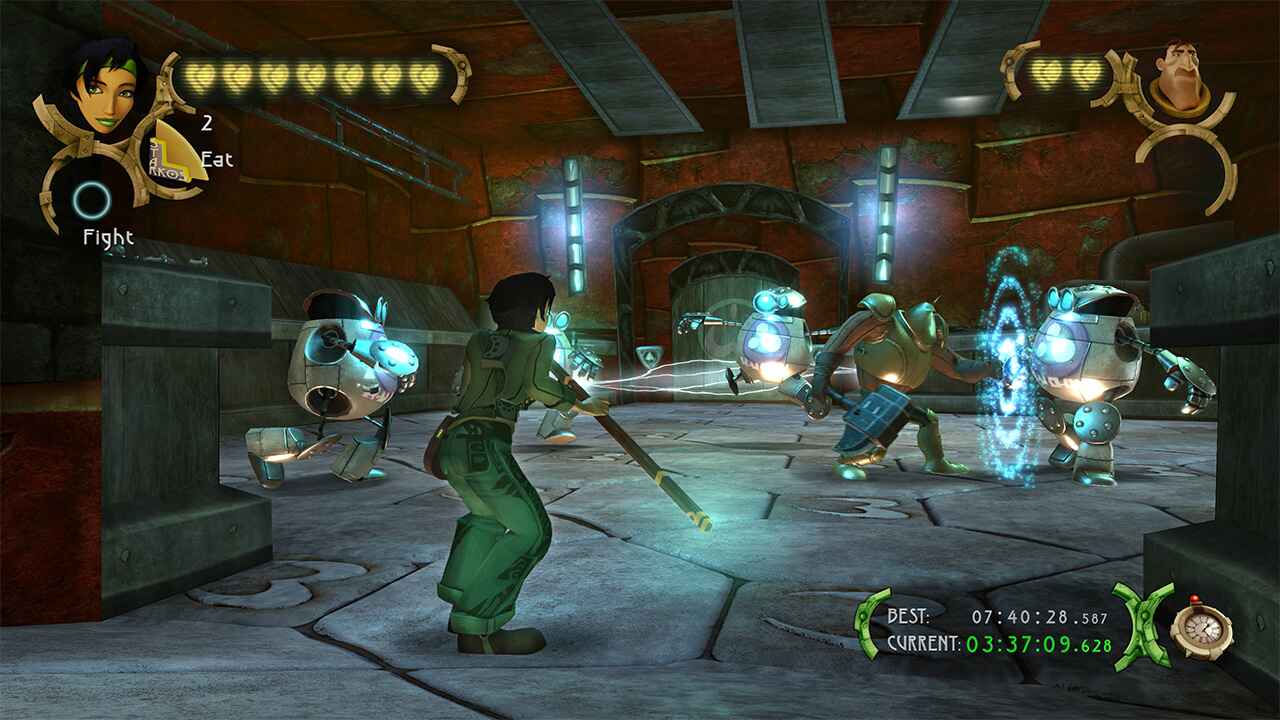
Unlike the other platforms this 20th Anniversary Edition was released on, its Nintendo Switch version is (obviously) not presented in 4k 60 frames per second (fps). It instead aims close to native resolution for either docked or handheld with a 30 fps target. I’d say it mostly hits that target, but it felt like it would dip down to 20-25 whenever intense battles were going on. I’m not sure what the exact resolution count was, but I thought the game looked quite gorgeous on my OLED undocked. Docked also looks nice, but I spent most of my time undocked. There were new textures made for this remaster, which have been apparently massively scaled down for this version.
Because I went in expecting a sixth gen game though, and really enjoy playing retro games on their own systems, I actually didn’t even notice that there was a texture downgrade compared to other modern versions. It makes it look similar to the original release, and I liked it a lot. The new lighting effects and reflections are attempted on Switch to solid results, with the only awkward adaptation being the heavily pixelated water reflections. The lighting is now intended to be real-time, leading to an unfortunate side effect where Jade’s skin is lighter in most shots in the game. I don’t think this was intentional, and I wouldn’t say she’s necessarily white now, but this is something I hope is able to be tweaked in a future patch.
As of version 1.0.1 (the latest software update) there’s an annoying “issue” that will block most players immediately upon booting up the game. Before being able to interact with even the menu, you are greeted with the following: “Playing Beyond Good & Evil while connected to the Internet requires you to be logged into a Ubisoft account. This will let you enjoy Ubisoft Connect Rewards. Please create your account or log in to your existing one.” My annoyance with this should speak for itself.
By trying to back out of this message it’ll attempt to load but just pop the same message back up. What frustrates me the most is that this is able to be bypassed with a couple of button presses, simply hold the Home button, turn on Airplane mode, and then back out. I don’t really get why this was done, and it just detracts in such a meaningless way. I hope this is patched out. Outside of this, I’d say the only other real issues I found with this version are with the subtitles. The position of the subtitle box is a bit too close to the middle of the screen, and the timing of them would sometimes be off.
Despite a couple of gripes, I’d still say this is probably going to be the best version of Beyond Good & Evil. It at least has the strongest intersection between accessibility and quality. The game runs and looks quite good on the system, with the handful of framerate dips not really detracting from the overall experience. I’ll admit, the brilliant quality of Beyond Good & Evil is doing a lot of the heavy lifting here. The remaster overall is quite good, with this Nintendo Switch version just being solid, I’d say. This is a good way to play one of the coolest games from the sixth gen, but there are definitely better places to play this version. If you’re used to concessions made with these kinds of ports though, you’ll probably have as great of a time as I did. While I’m sure Nintendo’s handheld won’t be able to run the second game whenever that resurfaces, I’m certainly a lot more interested in giving it a go than I was before.
Version Tested: Nintendo Switch
Review copy provided by Ubisoft